Each major city around Australia holds New Year’s Eve celebrations, usually accompanied by a fireworks display amongst other events. Gloucester Park, a racecourse in central Perth, is the largest and most recognised display in Perth. In Brisbane 50,000 people annually gather at sites around the Brisbane River in the city to watch a fireworks display while events are held in the city and at Southbank.
The two largest New Year's Eve celebrations in Australia are held in its two largest cities, Sydney and Melbourne. The celebrations in Sydney are usually accompanied by a theme which is displayed in light shows and a large symbol in the middle of the Sydney Harbour Bridge. Over 1.5 million people gathered around Port Jackson (Sydney attendance of 2 million people). The fireworks display last from 15 to 25 minutes and is followed by music shows set on several stages throughout the beach.
As one of the first major New Year's celebrations each year (due to time zones), Sydney's fireworks display is often broadcast throughout the world during the day of 31 December.
Thursday, December 31, 2009
New Year Celebrations In Australia
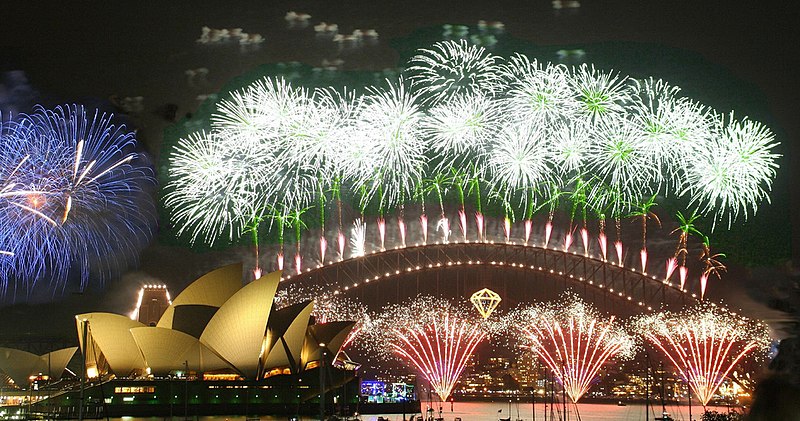
New Year's Eve
New Year's Eve or Old Year's Night is on 31 December, the final day of the Gregorian year, and the day before New Year's Day.
New Year's Eve is a separate observance from the observance of New Year's Day. In modern Western practice, New Year's Eve is celebrated with parties and social gatherings spanning the transition of the year at midnight.
Many cultures use fireworks and other forms of noise making in part of the celebration.
New Year 2010
The New Year is the day that marks the end of one year and the beginning of the next year, and is the day on which the year count is incremented. In many cultures, the event is celebrated in some manner.
Traditionally, the Roman calendar began the first day of March. However, it was in January (the eleventh month) when the consuls of ancient Rome assumed the government. Julius Caesar, in 47 BC, changed the system, creating the Julian calendar. It was modified in the time of Mark Antony consul in 44 BC, again by the emperor Augustus Caesar in 8 BC and finally by Pope Gregory XIII in 1582, which brought the calendar to its present day form. This year begins on January 1. Subsequently, this day was marked with a religious significance during the Middle Ages and later centuries.
With the expansion of Western culture to the rest of the world during the twentieth century, the January 1 date became universal in nature, even in countries with their own New Year celebrations (e.g., China and India).
At present, the celebration of New Year is a major celebration worldwide. Many large-scale events are held in major cities around the world New Year's Eve (December 31), being accompanied by the largest fireworks events.
In the culture of Latin America there is a variety of traditions and superstitions for these dates as omens for the coming year. January still remains a symbol of New Year's celebration.
According to the Christian tradition, on January 1 coincides with the circumcision of Christ (eight days after birth), when the name of Jesus (Luke (II: 21)).